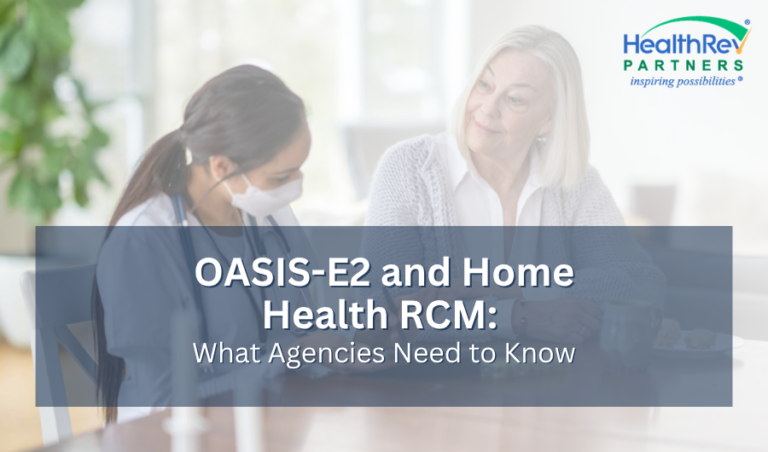

Home health agencies are now operating under OASIS-E2, and the impact reaches far beyond clinical documentation. With the new requirements in effect, agencies must make sure their assessment workflows, coding practices, and quality assurance processes support accurate reimbursement, quality reporting, and HHVBP performance.
In a margin-sensitive environment, precision is no longer optional. OASIS-E2 is now a revenue cycle issue, and agencies that adapt quickly are better positioned to protect claim integrity, reduce avoidable denials, and maintain strong financial performance.
What OASIS-E2 means now
OASIS stands for Outcome and Assessment Information Set, and it remains one of the most important assessment frameworks in home health care. It helps agencies capture clinical, functional, and psychosocial information that informs care planning, quality reporting, and reimbursement.
CMS has been mandated via the Improving Medicare Post-Acute Care Transformation (IMPACT) Act to standardize patient assessment data elements across all post-acute care settings (SNFs, IRFs, LTCHs and HHAs).
OASIS-E2 is the latest version and builds on that foundation with revised and new data elements across assessment timepoints. That means agencies must be especially careful that documentation is accurate, complete, and consistent across the entire patient record.
Why OASIS-E2 matters for home health RCM
Revenue cycle management in home health depends on one core principle: the documentation has to tell the full story. When assessment data is incomplete or inaccurate, the reimbursement picture becomes incomplete too.
HealthRev Partners has emphasized that OASIS-E2 is not just a clinical update. It is a revenue cycle event because it directly affects documentation accuracy, claim integrity, quality reporting, and HHVBP performance. In practical terms, that means every assessment item can influence how an agency is paid and how it performs under value-based purchasing.
A single documentation error may not seem significant in the moment, but over time those issues can create lost reimbursement, denials, compliance risk, and weaker quality outcomes. For agencies managing tighter margins, those misses can quickly become expensive.
How OASIS-E2 affects reimbursement
OASIS-driven reimbursement depends on whether the assessment accurately reflects the patient’s condition and the care resources required. When the assessment is precise, agencies are more likely to receive payment that matches the level of care delivered.
That matters even more now that reimbursement pressure remains high across the home health industry. Agencies need documentation that supports the claim from start to finish, because weak clinical detail can lead to payment delays, denials, or underpayment.
OASIS-E2 also plays a role in how agencies perform in value-based care models. Strong documentation helps demonstrate patient outcomes and supports quality performance, which can affect financial results under HHVBP.
What changed with OASIS-E2
The most important change is not just that OASIS has been updated, but that agencies now need to work with revised requirements in real time. New and revised data elements affect how patient status is captured across multiple assessment timepoints.
That creates a greater need for consistency between clinical documentation, coding interpretation, and QA review. If one part of the workflow is lagging behind the others, the agency can run into problems with claim accuracy and performance reporting.
It also means training matters more than ever. Clinicians, coders, and reviewers all need to understand how the revised OASIS elements affect the overall revenue cycle.
Common documentation risks
Even with a strong process, many agencies still struggle with the same recurring issues. These often include incomplete assessment items, weak clinical specificity, inconsistent functional scoring, and narratives that do not fully support the coded record.
These issues can create avoidable problems with reimbursement and quality results. They can also make it harder to defend claims if payers review them later.
The challenge is that many of these mistakes are subtle. A missing detail, a vague description, or a mismatch between the narrative and the coding may not be obvious at first, but it can still affect payment integrity and compliance.
Why quality reporting matters
OASIS-E2 is not only about reimbursement. It also affects quality reporting and the way agencies are measured in the market.
That matters because HHVBP rewards agencies that show strong outcomes, not just those that provide care efficiently. If the documentation is weak, the agency may not receive full credit for the care it is actually delivering.
Precise OASIS-E documentation helps agencies demonstrate value and optimize performance. In other words, good documentation supports both financial performance and quality outcomes.
HHVBP and financial pressure
Home health agencies are operating in an environment where every percentage point matters. As reimbursement pressure continues and margins tighten, the ability to capture accurate patient information becomes a business necessity.
OASIS-E2 affects HHVBP performance, which means documentation quality can directly impact how well an agency performs. Agencies with accurate assessments and consistent documentation practices are better positioned to protect both quality scores and financial outcomes.
This is why the conversation around OASIS-E2 should not stop at compliance. It must include strategic planning around revenue cycle performance, denial prevention, and quality optimization.
Why human review still matters
Technology can improve speed and consistency, but it cannot fully replace clinical judgment. OASIS-E2 requires interpretation, context, and an understanding of how patient conditions should be reflected in the final assessment.
That is where human review becomes essential. Skilled reviewers can catch subtle documentation gaps, identify inconsistencies, and make sure the assessment tells a complete and defensible story.
For agencies trying to balance efficiency with accuracy, the best model is usually a hybrid one. Technology can support the workflow, but expert oversight protects the integrity of the final record.
How HealthRev Partners helps
HealthRev Partners supports agencies through expert OASIS-E coding, quality assurance review, and workflow alignment that helps documentation support reimbursement accuracy. The goal is to make sure agencies are not just compliant, but also operationally strong.
We also use technology-driven support through Velocity, along with real-time reporting and dedicated account management, to help agencies identify issues and improve performance. That kind of structure is especially helpful now that OASIS-E2 is active and agencies need to adjust quickly.
More so, HealthRev Partners emphasizes customized support and dual-certified expertise, which can help agencies strengthen documentation quality without overloading internal teams. That is particularly valuable for organizations that need to maintain speed while protecting claim integrity.
Best practices for agencies
Agencies can strengthen their OASIS-E2 performance by improving documentation consistency across the organization. That includes clinician education, coding alignment, QA review, and ongoing trend analysis.
A strong process should also connect clinical documentation to revenue cycle priorities. When clinicians understand how their documentation affects reimbursement, denials, and quality reporting, they are more likely to capture accurate data at the point of care.
It is also helpful to review documentation patterns regularly. Looking for trends in errors, missed items, and recurring inconsistencies can help agencies address problems before they become costly.
A better workflow for RCM
The best home health RCM workflows do not treat assessment documentation as a separate task. Instead, they connect it to coding, billing, quality assurance, and leadership oversight.
That approach makes it easier to catch issues early and reduce avoidable rework later in the cycle. It also improves communication across teams, which is critical when OASIS-E2 requirements affect so many parts of the business.
Agencies that build this kind of integrated workflow are more likely to protect margins and support sustainable growth. In a tightening reimbursement environment, that can be a major competitive advantage.
The business case for accuracy
Accurate OASIS-E2 documentation is an investment in agency stability. Better documentation supports higher reimbursement, improved cash flow, enhanced compliance, and better patient outcomes.
Those benefits do not just apply in theory. They compound over time, especially when an agency consistently reduces denials, improves quality performance, and maintains cleaner claims.
For home health leaders, the message is straightforward: documentation quality is not an admin detail. It is a core business function that affects how well the agency performs financially and clinically.
What agencies should focus on now
Now that OASIS-E2 is in effect, agencies should focus on operational execution. That means reviewing documentation workflows, strengthening QA processes, and ensuring teams understand how the revised requirements affect the final assessment.
It also means paying attention to claim integrity. If the assessment, coding, and billing processes are not aligned, the agency may face avoidable denials or payment problems.
This is the right time to treat OASIS-E2 as a permanent part of revenue cycle strategy, not a temporary training issue. The agencies that do that will be better positioned to succeed in a value-based market.
Final thoughts
OASIS-E2 is one of the most important developments in home health RCM because it connects patient care, documentation, quality, and payment in a single workflow. Now that the changes are live, agencies need to move from preparation to execution.
The agencies that will perform best are the ones that protect claim integrity, strengthen QA review, and align coding with the realities of care delivery. In a financially pressured environment, that level of precision can make a meaningful difference.
HealthRev Partners is positioned to help agencies meet that challenge through expert coding, workflow support, and reporting that improves visibility across the revenue cycle. For organizations focused on home health reimbursement and performance, OASIS-E2 is not just a compliance update, it is a strategic priority.