
Growth is a positive sign for any home health agency, but it can also expose revenue cycle processes built for a much smaller operation. As census rises, billing volume, documentation demands, payer requirements, and follow-up responsibilities rise with it.
If those processes do not scale alongside the agency, growth can begin to strain cash flow rather than strengthen it. Claims take longer to submit, denials repeat, accounts receivable ages, and leadership loses visibility into what is holding up reimbursement.
Here are seven signs your agency may have outgrown its current revenue cycle processes, along with practical questions to help identify where support is needed.
1. Census Growth Is Outpacing Billing Capacity
An increasing census should lead to stronger revenue, but only when the revenue cycle can keep pace. When admissions rise faster than the team’s ability to verify coverage, review documentation, code records, submit Notices of Admission, bill claims, post payments, and work A/R, growth can put pressure on cash flow.
The strain often appears gradually. Team members work overtime, postpone routine follow-up, or rely on manual worklists to keep claims moving. Eventually, claims wait longer for review, denials receive delayed attention, and clinical teams spend more time responding to billing questions.
A process that worked effectively at 100 patients may not be sufficient at 250, 500, or 1,000+ patients. The issue may not be employee performance. It may be that volume and complexity have outgrown the operating model.
What to evaluate: Look beyond headcount. Compare growth in admissions, claims, denials, and payer-specific exceptions with changes in turnaround time. If volume is rising while timeliness is declining, your agency may have a capacity or workflow problem.
2. Claims Are Waiting Too Long to Be Submitted
A complete claim sitting in a queue is revenue that has not yet entered the payment cycle. Delayed billing can postpone payment, delay the discovery of denials, increase A/R, and create greater exposure to payer filing limits.
Common causes include incomplete documentation, unsigned orders, OASIS issues, coding questions, missing authorizations, eligibility concerns, or unclear ownership between clinical and billing teams. The key is to distinguish a claim that is legitimately waiting on information from one that is simply waiting for someone to act.
For Medicare home health claims, OASIS and claims data must align for processing. CMS advises agencies to confirm that the applicable assessment has been accepted before submitting the associated claim. Review CMS guidance on required patient assessment information.
The goal is not merely to get claims out quickly. It is to submit clean, timely claims with the documentation and data needed to support reimbursement.
What to evaluate: Track the average time from the end of the billing period to claim submission by payer, branch, and location. Then identify why claims are held. Recurring hold reasons usually point to a workflow, training, capacity, or ownership issue that needs to be addressed upstream.
3. Accounts Receivable Over 90 Days Continues to Grow
Some aging is expected, especially for agencies managing multiple payers, authorizations, appeals, and complex claim issues. A consistently growing 90-plus-day A/R balance, however, can indicate that unresolved claims are not receiving timely attention or that recurring billing problems are not being corrected.
Aged A/R may be tied to late submissions, denials awaiting action, unrecognized underpayments, requests for additional documentation, eligibility or authorization issues, or unclear ownership of follow-up tasks.
Older A/R does not automatically mean a claim is uncollectible. It does mean the agency needs to understand why the balance is aging, whether a filing or appeal deadline applies, and what action is required next. Without that visibility, recoverable claims can remain buried under newer work.
What to evaluate: Segment A/R by payer, location, age bucket, claim status, denial category, and work queue. For each major balance, leadership should be able to answer four questions: Why is it outstanding? Who owns the next action? When will that action occur? What process change could prevent the same issue in the future?
4. The Same Denials Keep Recurring
Every home health agency encounters denials. The warning sign is repetition. When a team repeatedly corrects the same denial types without addressing their causes, denial management becomes a cycle of rework rather than a source of operational improvement.
Recurring denials may involve eligibility, missing documentation, coding inconsistencies, certification issues, authorization requirements, timely filing, or claim data that does not support payment. Resolving the individual claim matters, but preventing the next denial matters too.
For example, repeated documentation-related denials may call for earlier record review, focused clinician education, clearer ownership of orders, or a tighter handoff between clinical and billing teams. Repeated coding denials may point to the need for coding audits, updated education, or specialized support.
An effective denial process categorizes denials by payer, reason, dollar amount, and branch; assigns clear ownership; protects correction and appeal deadlines; and reports whether prevention efforts are reducing repeat issues.
What to evaluate: Ask your team to identify the five most common denial reasons from the past 90 days. If the answer is unclear, or if the same reasons have appeared for multiple quarters, the agency needs stronger denial reporting and root-cause prevention.
5. Too Much Knowledge Rests With One Employee
Many agencies rely on a long-tenured biller, coder, or A/R specialist who knows how everything works. That experience is valuable. It becomes an operational risk when critical workflows, payer rules, system access, reporting processes, relationships, or historical knowledge exist primarily with one person.
Key-person dependence can disrupt billing when an employee takes leave, changes roles, retires, or resigns. It can also limit growth because other team members cannot provide backup coverage or confidently assume new responsibilities.
Only one person knows how to submit or correct certain claims.
One employee is the sole contact for a major payer issue.
Billing procedures are undocumented or outdated.
A team member’s absence immediately creates delays or confusion.
Leadership cannot independently validate revenue cycle performance.
A scalable operation captures employee expertise through documented workflows, cross-training, quality controls, dashboards, and backup coverage.
What to evaluate: If one key employee were unavailable for two weeks, could your agency continue submitting claims, working denials, posting payments, answering payer questions, and producing accurate reports? If not, continuity planning should become a priority.
6. Leadership Lacks Clear, Timely Reporting
Agency leaders need more than a bank balance or total A/R figure. They need timely, reliable visibility into the revenue cycle so they can make informed decisions about staffing, growth, payer strategy, branch performance, and operational priorities.
Without that visibility, a backlog or denial trend may go unnoticed until cash flow is affected. By then, the agency may be facing a larger A/R balance, increased write-offs, payer friction, or an urgent staffing problem.
A useful home health revenue cycle dashboard may include:
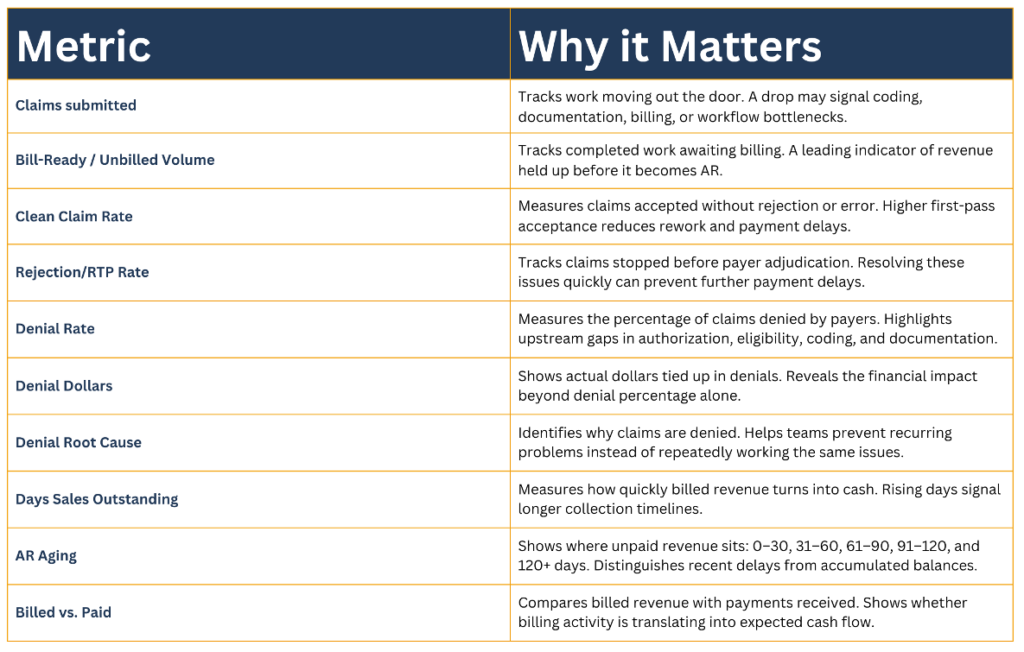
What to evaluate: If leadership asked today why A/R increased, which payers are slowing payment, what the leading denial reasons are, and how much revenue remains unbilled, could the team answer accurately and quickly? If every answer requires last-minute spreadsheet work, the reporting infrastructure may no longer support the agency’s needs.
7. Your Team Spends More Time Fixing Problems Than Preventing Them
The final sign is a culture of constant reaction. The team stays busy correcting claims, chasing documentation, resubmitting, explaining, and escalating, but has little time to prevent the issues creating that work.
Constant rework is not always just a process problem. It can also reflect breakdowns in communication, trust, ownership, and alignment across teams. In this episode of Home Health Revealed, Chris Taylor explains how organizational health shapes performance and why unity is often the most overlooked part of the equation.
Common examples include correcting the same claim errors each week, chasing missing orders as billing deadlines approach, escalating payer issues only after balances have aged, relying on manual checks to compensate for inconsistent upstream controls, and regularly using overtime to recover from backlogs.
A stronger revenue cycle moves prevention upstream. It identifies missing information before billing, catches documentation and coding concerns earlier, monitors submission timelines, prioritizes high-risk A/R, and uses denial trends to guide education and workflow improvements.
What to evaluate: Review the issues that consumed the most staff time during the past month. How many were isolated exceptions, and how many were repeat problems? If the same work keeps returning, the agency needs time, ownership, and reporting dedicated to prevention.
Choosing the Right Level of Support
Recognizing that your revenue cycle has outgrown its current processes does not automatically mean fully outsourcing the billing department. The right solution depends on the team’s expertise, capacity, technology, growth plans, payer mix, and financial goals.
Strengthen Your Internal Team
Some agencies have a capable, stable team but need stronger workflows, training, accountability, or reporting. Process mapping, KPI development, denial analysis, coding education, cross-training, and interim consulting may provide the structure needed to support growth.
Add Support for One Revenue Cycle Function
Other agencies need targeted help in a specific area, such as home health coding, billing support, denial management, A/R follow-up, or revenue cycle consulting. Focused support can address a backlog or specialized skill gap while allowing the agency to retain other functions internally.
Choose Comprehensive Home Health RCM Support
Agencies facing persistent billing backlogs, growing aged A/R, recurring denials, limited internal capacity, or inconsistent reporting may benefit from comprehensive RCM support. A strategic partner can connect coding, billing, claims management, payment posting, denial resolution, A/R follow-up, reporting, and strategic guidance. The purpose is not to remove leadership from the process. It is to give leaders better visibility, more consistent performance, and an infrastructure that can scale with the agency.
Build a Revenue Cycle That Supports Growth
Your revenue cycle should support the agency’s success, not become the factor that limits it. Rising census, delayed claims, aging A/R, recurring denials, unclear reporting, and persistent rework are not simply daily frustrations. Together, they can signal that the current process needs to evolve.
HealthRev Partners helps home health agencies evaluate and improve the processes behind reimbursement. Whether your organization needs home health coding support, billing expertise, A/R recovery, denial management, revenue cycle consulting, or comprehensive RCM services, the right strategy can help protect cash flow, reduce rework, and create a stronger foundation for growth.
Ready to assess your revenue cycle? Connect with HealthRev Partners to identify the gaps, prioritize the highest-impact opportunities, and build a revenue cycle strategy that can grow with your agency.